


Baby’s Language Development Guide
Baby’s Language Development Guide
I finally understood what to do with my baby each week. No more guessing whether everything is going the way it should.
Find out where your baby's language should be - based on their exact age, not general standards
- ✓A personalised language plan for your baby's exact age - stage by stage
- ✓Science-based activities you can do at home with no equipment
- ✓Discover what your baby really understands - long before the first word
- ✓A clear explanation of why each activity matters and what it builds
- ✓When to worry and when to simply carry on - no pointless googling in the middle of the night
Couldn't load pickup availability
Online you'll find contradictory information from countless sources - no one has pulled it together in one place, by age, specifically for language. This guide is built on speech and language research and clear developmental milestones. Everything's structured and stage by stage.
No. Every technique is described step by step and can be done at home with no equipment - during feeding, bath time and play. No experience needed - just the willingness to spend 10-15 minutes a day talking, reading and playing with your baby.
That's exactly who this guide is for. It shows you where your baby is now, the activities that build the very skills still developing, and gives you clear red flags - so you know precisely when it's worth seeing a speech therapist, not too early and not too late.


WHY THIS MATTERS
Your baby isn't talking yet. Everyone says wait. But when should you really worry?
Language development is one of the most common sources of parental worry. "Is it normal that she isn't saying words yet?", "Why isn't he talking like the neighbour's child?" - these thoughts keep thousands of parents up at night.
But the science is clear: the foundation of language is laid from day one - long before the first word. Every conversation, book and song is not just entertainment. It is a direct investment in your baby's language centres.
The problem is that no one tells you exactly what to expect at each age, what to do every day, and when you genuinely need to see a specialist. Until this guide.

WHAT'S INSIDE
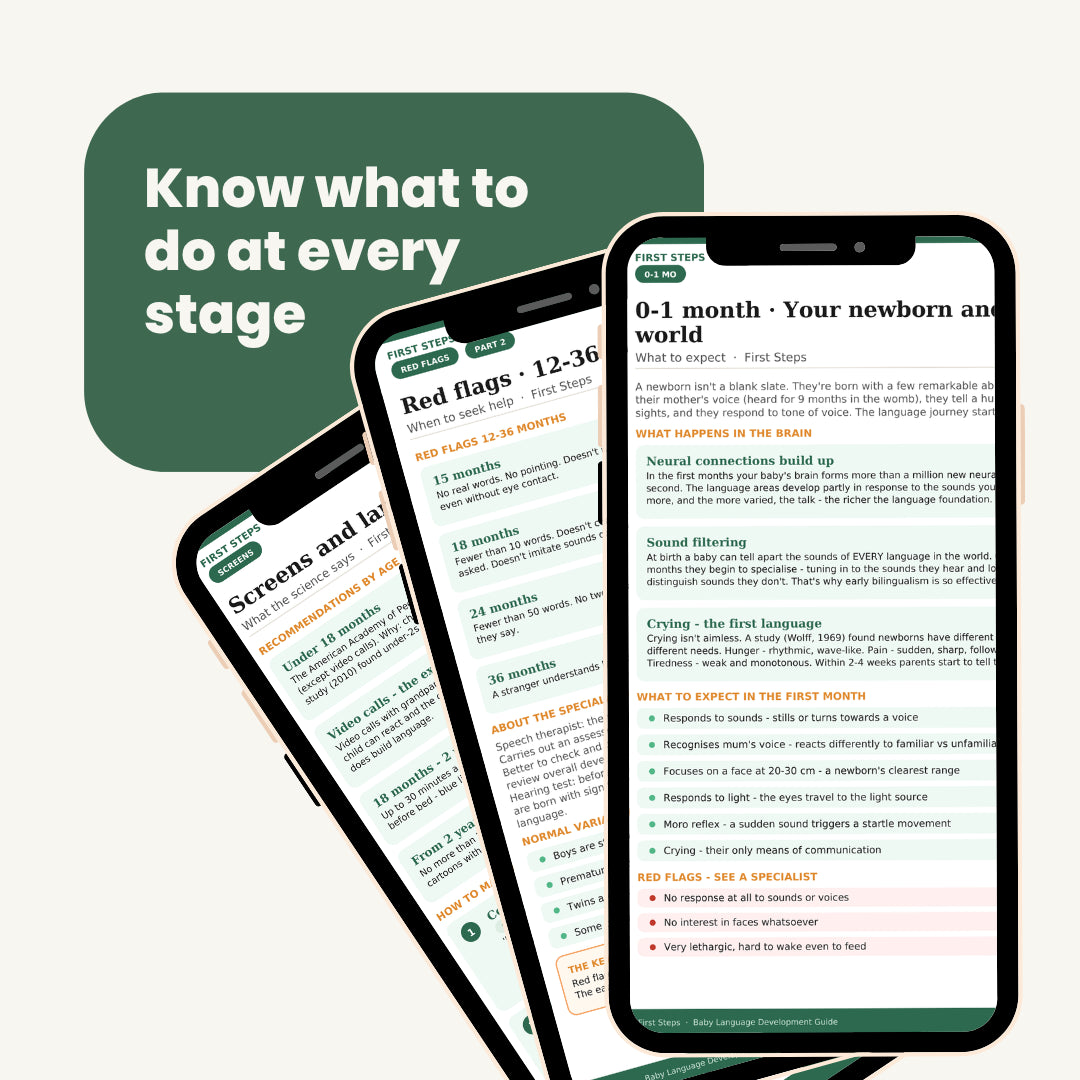
Language development from 0 to 3 years. Everything you need to know.
For every age stage - what to expect, what to do each day, and how to recognise when you genuinely need to see a specialist.
Language development month by month
From first sounds to full sentences - exactly what to expect at 0-3, 6, 9, 12, 18, 24 and 36 months. A clear table, not vague descriptions.
How to talk to your baby
Serve and return, sportscasting, language enrichment - specific techniques you can use during feeding, bath time and play. Not theory - practice.
Books, songs and games
Which games best build language at each age. How to read a book so it actually works - not just showing pictures. Songs and their effect on the language centres.
Screens and language development
How much screens really affect language - what the science says, not fear. Up to what age to avoid them, and from when (and what content) may be appropriate.
Bilingualism
Does learning two languages slow speech down? How do you combine English and another language? The research gives a clear answer - and it will surprise you.
Red flags
The exact signs of when you genuinely need to see a speech therapist or GP - by age. Not "just wait" - clear criteria that help you decide.
GUIDE STRUCTURE
From first sounds to full sentences
Language develops in stages - and each stage has its own logic. The guide moves right alongside your child.
The foundations, before the first words
- Why language begins from day one
- Serve and return - the most important technique
- What your baby understands before speaking
- How to respond to your baby's sounds and smiles
- Songs and their effect on the brain
- What to expect: cooing, smiling, sounds
Understanding grows faster than speech
- 9 mo: understands 20-50 words - how to use it
- Mama, dada - when they are real words
- Pointing - a crucial developmental milestone
- Reading books - how and how much
- Games that build listening and understanding
- What to expect and when to worry
First words and the word explosion
- First word - when it's normal, when it isn't
- The word explosion - what it is and why it happens
- 18 mo: 10-50 words is the norm
- How to encourage new words every day
- Sportscasting - technique and examples
- Red flags at 18 and 24 months
Sentences and social language
- Two- and three-word sentences
- The age of questions - how to answer usefully
- Stuttering - when it's normal, when it isn't
- Social language: greetings, interaction
- When and how to see a speech therapist
- What to expect at 3 years old
SCIENCE AND RESEARCH
Based on research, not forum advice
This guide is built on research from speech and language therapy, neuroscience and child psychology. There's no "my child started talking late too and everything turned out fine" - only what the science says.
Hart and Risley study (1995, University of Kansas)
This 30-year-old study is still cited as one of the most important. A child's vocabulary correlates directly with the number of words they heard in their first 3 years. The gap: 3 million words.
Harvard University "Center on the Developing Child"
Serve and return interaction - a baby's sound or gaze and the parent's response - is the most evidence-based technique for language and brain development. It builds neural connections directly.
Royal College of Speech and Language Therapists (RCSLT)
Provides the precise language milestones by age and clear guidance on when to see a specialist. These guidelines form the basis of this guide's "red flags".

WHO THIS GUIDE IS FOR
This guide is for you if...
IT'S FOR YOU
NOT FOR YOU
REVIEWS
What parents say
"My son was 15 months and only said 3 words. I didn't know whether to worry or wait. This guide finally told me clearly what to expect and what to do. A month later he was saying 12 words."
"We're raising our daughter in two languages and everyone said it would slow her speech down. This guide explained why that's a myth and how to combine them properly. Now we do it without any worry."
"The serve and return technique changed everything. I would never have thought you could build language so simply through the daily routine. My son started talking far more."

- Choosing a selection results in a full page refresh.
- Opens in a new window.